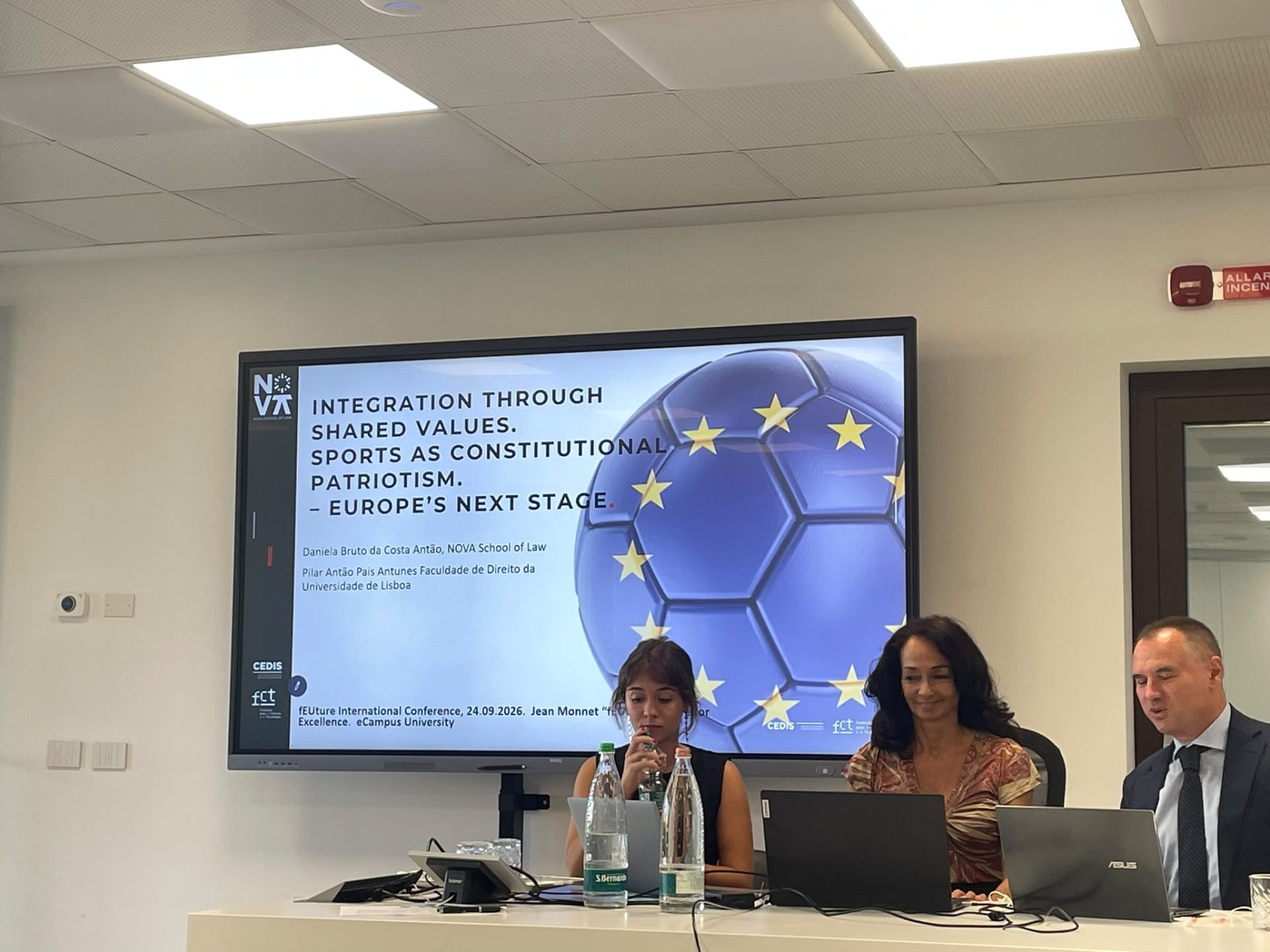
Could sport become a new vehicle for European integration? This was one of the questions explored at the third international conference The Follow-Up of the Conference on the Future of Europe: Translating Citizens’ Proposals into Law and Treaty Reform, held on 24-25 September at eCampus University in Novedrate, Italy.
Organised by the Jean Monnet Centre of Excellence fEUture, coordinated by Prof. Roberto Castaldi, the conference brought together researchers, academics and stakeholders to discuss how citizens’ proposals for the future of Europe can be translated into law, policy and institutional reform. The Centre’s work builds on the legacy of the Conference on the Future of Europe, fostering dialogue across disciplines and encouraging broader civic engagement with European issues.
Daniela Antão, whatnext.law scholarship holder and CEDIS researcher, presented an intergenerational reflection together with her daughter, a second-year law student at the Faculty of Law of the University of Lisbon. Their contribution highlighted how debates about European integration increasingly engage different generations in imagining and shaping a common European future.
Entitled Integration Through Shared Values: Sports as Constitutional Patriotism – Europe’s Next Stage, the paper explores whether sport could serve as a new catalyst for European integration. As a thought experiment, the authors propose the creation of a European Sports Union, beginning with an EU football team and a dedicated international competition in which the European Union would compete under its own flag.
The proposal is grounded in the idea that national and European identities can coexist, much as national citizenship and European Union citizenship already do. Rather than replacing national teams, an EU team would seek to complement them, creating an additional space through which European identity could be expressed and experienced.
Drawing on Eric Hobsbawm’s reflections on the role of football in nation-building, the paper argues that sport possesses a unique capacity to transform abstract political communities into tangible realities. As Hobsbawm famously observed, “The imagined community of millions seems more real as a team of eleven named people.”
The authors further draw on Jürgen Habermas’ concept of constitutional patriotism, suggesting that shared support for a common team may foster emotional attachment to a community founded on democratic values, institutions and fundamental rights. They also invoke Robert Putnam’s theory of social capital, arguing that if community integration can strengthen cohesion at the local level, similar mechanisms may contribute to building a stronger sense of belonging at the European level.
Whether such a vision is politically feasible remains open to debate. Yet the proposal raises broader questions about the future of European integration and the role that culture, identity and collective experiences may play in shaping it. Beyond institutions, markets and legal frameworks, what shared experiences might help Europeans imagine themselves as part of a common political community?
The article will be published in the journal Perspectives on Federalism.
Read the presentation here.


